
Japan Government Bond Redemption: Signs of Distrust in Fiscal and Monetary Policy
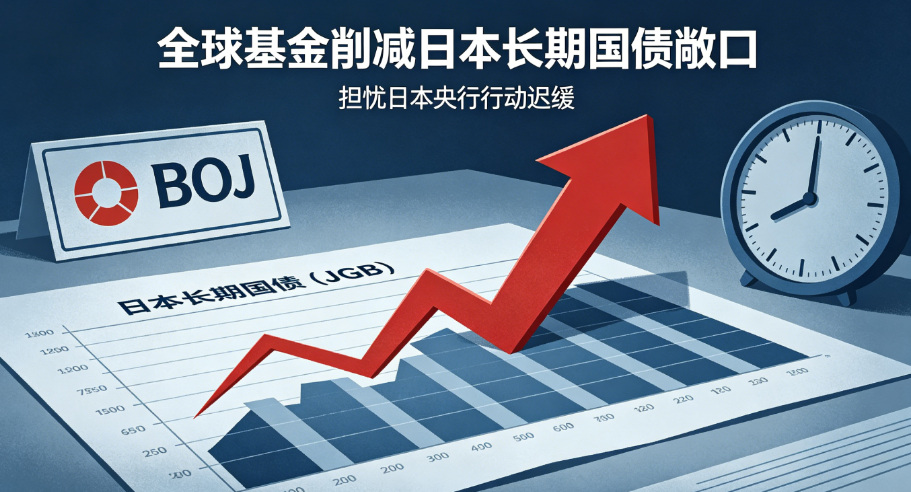
Despite Japanese government bond yields rising to multi-decade highs, which would typically attract foreign investors back to the market, the opposite has occurred this year. Several global institutional investors, including T. Rowe Price, Schroders, and Brandywine Global Investment Management, have gradually reduced their holdings of long-term Japanese government bonds, reflecting concerns more fundamental than yield.
April data showed that foreign investors became net sellers of Japan's ultra-long-term government bonds for the first time since early 2024, indicating that non-quantitative factors such as confidence in policy direction are becoming major obstacles.
Concerns Over Monetary Policy Lag
At the core of the issue is the market's belief that current prices or higher yields are still insufficient to compensate for the risks posed by the Bank of Japan's lagging policy actions. Although the BOJ plans to raise interest rates again this Tuesday, many investors believe the increase may be too small and too late to control inflation or reverse the negative real interest rate environment.
Carol Lye, portfolio manager and senior analyst at Brandywine Global, said: "Given the negative real interest rates in Japan, we believe the BOJ is somewhat behind where it should be." Her firm has reduced holdings of Japanese government bonds and sold 30-year bonds to shift into UK government bonds (gilts), indicating that cross-border capital allocation is shifting based on confidence in the effectiveness of each country's monetary policy.
Lye added that although "the valuation of JGBs has improved in terms of value," "structural supply and demand remains complex." This complexity includes the BOJ gradually reducing its market intervention role, while traditional domestic buyers have not yet returned strongly, creating a vacuum that foreign investors are reluctant to fill.
Fiscal Pressure and Political Uncertainty
Beyond concerns about the BOJ, Japan's fiscal stability is another issue causing investor hesitation. Vincent Chung, portfolio manager at T. Rowe Price, revealed that he bought after being underweight JGBs in January.