
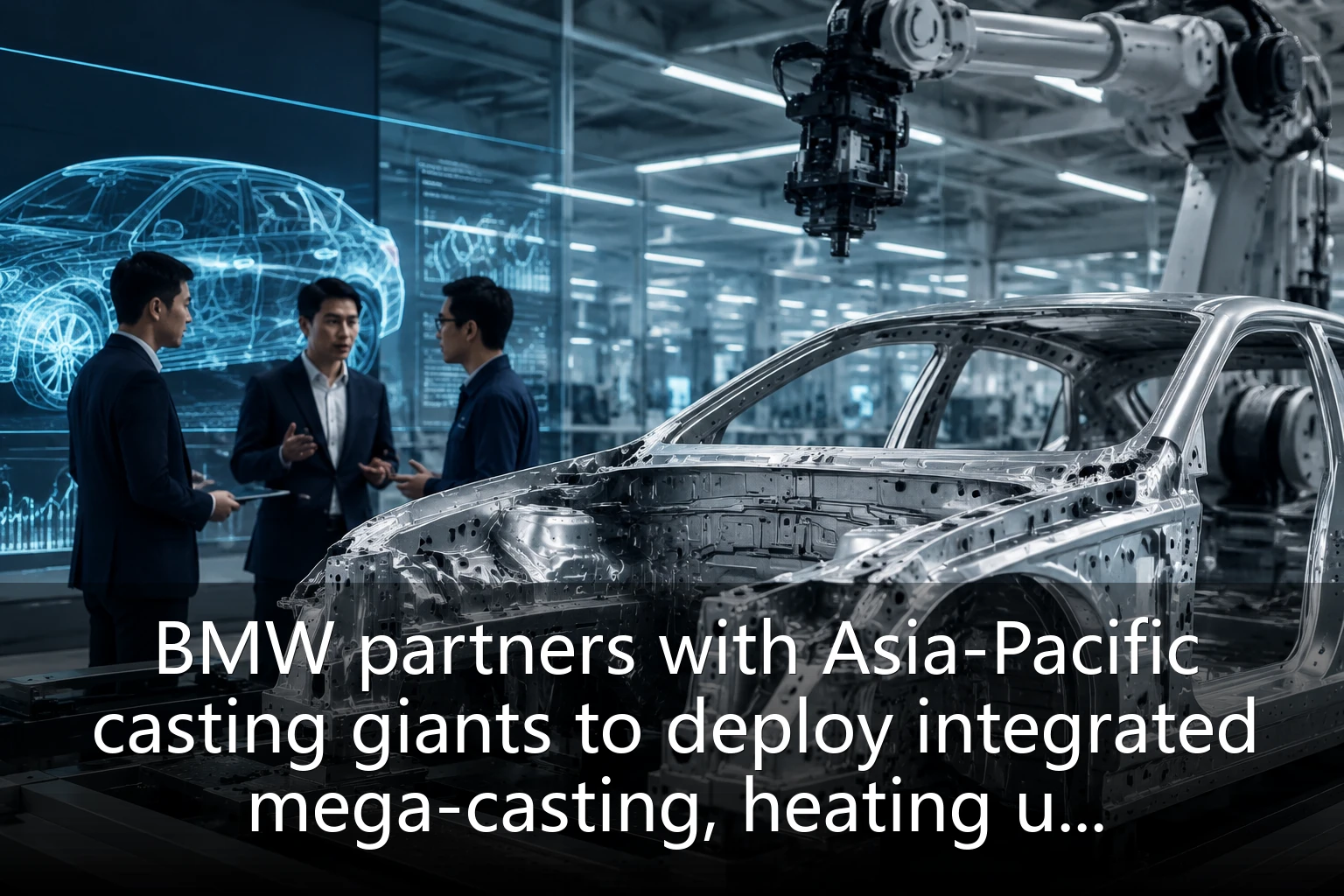
Major Partnership: BMW Joins Forces with Asia-Pacific Casting Giants, Securing Next Five Years of Mega-Casting Capacity
On July 29, 2026, simultaneous announcements from Munich and Bangkok—BMW Group officially reached deep strategic cooperation with two leading Asia-Pacific foundries to co-develop and mass-produce next-generation ultra-large integrated mega-cast parts. The two partners are ThaiCast Industries, Thailand's aluminum casting leader, and Hyundai Precision & Casting, a Korean precision casting expert. Under the agreement, BMW will invest approximately €1.2 billion to build three dedicated mega-casting production lines in the Asia-Pacific region, expected to supply key structural parts such as front cabin, rear floor, and battery housing for BMW's next-generation Neue Klasse EV platform starting 2028.
Joachim Post, member of BMW Group Board and head of Purchasing and Supplier Network, stated: "Integrated mega-casting is the core technology for achieving our dual goals of 'lean manufacturing' and 'carbon neutrality.' The Asia-Pacific region boasts the world's most dynamic casting industry clusters and a rapidly growing EV market. We are delighted to advance this revolutionary process with ThaiCast and Hyundai Precision."
Technological Breakthrough: From 6,000 Tons to 12,000 Tons, Mega-Casting Reaches New Heights
Integrated mega-casting (Giga Casting) has been the most notable process innovation in automotive manufacturing in recent years. Compared to traditional stamping and welding, it merges dozens of parts into one, drastically reducing weld points, lowering weight, and improving body rigidity. BMW previously deployed 6,000-ton die-casting machines at its Dingolfing plant in Germany. This cooperation will employ more advanced 12,000-ton ultra-large machines, jointly supplied by Switzerland's Bühler Group and Japan's Ube Industries, designed to produce single structural parts over 3 meters in length.
ThaiCast Industries' CTO Somchai Ratanavijarn revealed: "We will co-develop a new Al-Mg-Sc alloy that maintains excellent casting fluidity while improving tensile strength by 30% and achieving a recycling rate over 95%. BMW requires the proportion of recycled aluminum to rise from the current 50% to 75%, imposing extremely high demands on alloy formulation and casting processes." Hyundai Precision has innovated in mold thermal management and intelligent real-time monitoring, reducing production cycle time to under 90 seconds and targeting a yield rate above 97%.
Market Impact: Asia-Pacific Foundries Face Tens of Billions in Demand, Capacity Expansion Accelerates
BMW's cooperation is not an isolated event. In the first half of 2026, investments related to integrated mega-casting in the Asia-Pacific region exceeded $4.5 billion, involving multiple automakers such as Volkswagen, GM, and Tesla. The automotive lightweight casting market reached $62 billion in 2025, with a projected compound annual growth rate above 12% from 2026 to 2030. Aluminum alloy castings dominate, while magnesium alloy castings, offering better weight reduction but higher cost, are in a rapid penetration phase.
ThaiCast Industries, Southeast Asia's largest aluminum casting company, saw its share price rise 8.7% after the announcement. It plans to double capacity at its Thai plant and add three new mega-casting lines by 2027. Hyundai Precision is building a fully automated smart casting factory in Ulsan, South Korea, with a total investment of about KRW 1.8 trillion, serving Hyundai Motor Group's EV platforms. The capacity expansion of the two firms will further cement the Asia-Pacific region's core position in the global casting supply chain.
Notably, BMW's cooperation has also boosted upstream equipment and materials sectors. Bühler Group reports its die-casting machine orders booked through 2028, while aluminum suppliers such as Alcoa and Rusal have announced increased recycled aluminum capacity in Southeast Asia. Cross-border supply chain synergy is significant, making casting clusters in Thailand, Vietnam, and Indonesia hotspots for foreign investment.
Policy & ESG: Green Casting Becomes Competitive Divide
The adoption of integrated mega-casting has profound environmental impacts. Traditional stamping and welding produce about 200 kg of scrap per body structure set, while mega-casting scrap rates are below 5% and easily recyclable. BMW requires its casting suppliers to achieve 100% green electricity by 2028 and reduce carbon emission intensity by 50% from 2020 levels by 2030. ThaiCast has built a 150 MW rooftop solar project in Rayong, Thailand, and plans to participate in carbon credit trading. Hyundai Precision has signed a long-term green power purchase agreement with Korea Electric Power Corporation.
Analysts point out that ESG performance is becoming a key threshold for foundries to secure orders from international automakers. Asia-Pacific foundries that fail to meet carbon emission and circular economy standards risk losing premium customers. Those investing early in green technology and establishing carbon footprint traceability systems are likely to enjoy higher valuation premiums in the coming years.
Industry Outlook: From Manufacturing to Service, Foundry Roles Evolve
Integrated mega-casting is not just a process innovation; it is pushing foundries toward deep R&D and project management transformation. In the traditional OEM model, foundries produce to drawings. Now, under the partnership framework, they must participate in early design, alloy development, mold simulation, and even vehicle crash safety validation. ThaiCast and Hyundai Precision have both set up in-house EV technology research centers, co-locating with BMW engineers for joint development.
"We are no longer 'selling castings' but 'selling solutions'," said Hyundai Precision President Lee Sung-ho. "This cooperation has given us end-to-end capabilities from material R&D to finished product delivery, and we may even independently undertake vehicle structural part development projects for other automakers in the future." This role upgrade greatly enhances foundries' bargaining power and profit margins. According to investment bank estimates, gross margins for mega-casting parts can reach 25%-30%, far exceeding the 15%-18% for traditional castings.
As giants like BMW, Mercedes-Benz, and Toyota accelerate deployment, integrated mega-casting is set to enter a scale explosion phase in 2027-2028. The Asia-Pacific Casting Market Watch will continue tracking capacity expansion, technology iteration, and investment opportunities in this field, providing in-depth decision-making references for industry participants.