
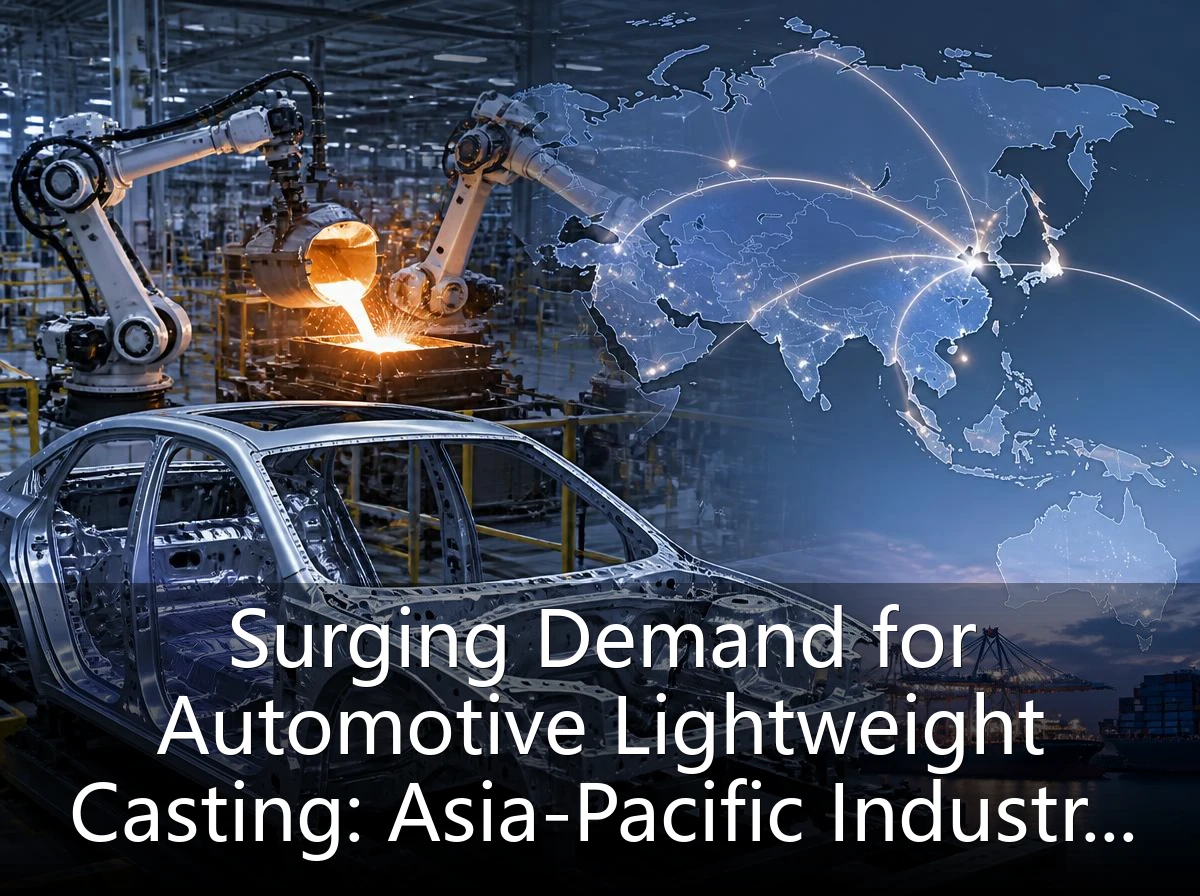
Surging Demand for Automotive Lightweight Casting: Asia-Pacific Industry Chain Restructuring and Investment Opportunities
\n\nIn 2026, the global automotive industry is undergoing unprecedented transformation, with electrification, intelligence, and connectivity trends reshaping the industry landscape. Against this backdrop, automotive lightweight casting technology has become a key force driving industrial upgrading. As the world's largest automotive production and consumption market, the Asia-Pacific region is witnessing explosive growth in demand for lightweight casting, with upstream and downstream enterprises actively positioning themselves, and investors also turning their attention to this promising field.
\n\nLightweight Casting: The Inevitable Choice in the New Energy Vehicle Era
\n\nWith the popularization of new energy vehicles, vehicle range, safety performance, and energy efficiency have become key consumer concerns. While traditional steel materials offer high strength, their large density is unfavorable for vehicle weight reduction. In contrast, lightweight metal materials such as aluminum and magnesium alloys, with their high strength, low density, excellent casting properties, and recyclability, have become the ideal choice for automotive lightweighting.
\n\nAccording to industry data, using aluminum alloy bodies can reduce vehicle weight by 30%-40%, significantly improving energy efficiency. For pure electric vehicles, every 10% weight reduction can increase range by approximately 6%-8%. This data has directly driven the surge in demand for lightweight casting technology among automakers.
\n\nThe breakthrough in integrated die-casting technology has further accelerated this trend. Tesla pioneered the use of large-scale die-casting machines to produce vehicle rear underbody panels, integrating what was originally a component consisting of over 70 parts into a single piece, significantly reducing production costs and weight. This innovation quickly triggered industry-wide follow-up, with major automotive manufacturers in the Asia-Pacific region increasing their R&D investment in related technologies.
\n\nAsia-Pacific Market: Explosive Growth in Lightweight Casting Demand
\n\nAs the core region of the global automotive industry, the Asia-Pacific region is becoming the primary application market for lightweight casting technology. According to the latest research data from OceanRing Asia-Pacific Finance, the automotive lightweight casting market in the Asia-Pacific region reached $86 billion in the first half of 2026, a year-on-year increase of 32.5%, with the full-year market expected to exceed $120 billion.
\n\nAs the largest automotive market in the Asia-Pacific region, China is particularly strong in demand for lightweight casting. Driven by the government's "dual carbon" goals, the penetration rate of new energy vehicles continues to rise, reaching 45.3% in the first half of 2026, which has directly led to tremendous demand for lightweight casting technology. Leading domestic casting enterprises such as Guangdong Hongtu and Wencan Co., Ltd. are expanding their production capacity and positioning themselves in integrated die-casting technology.
\n\nJapan and South Korea maintain technological leadership in the high-end precision casting sector. Japanese casting enterprises such as Higashi-Kurume Industry and Sankyo Seisakusho focus on the manufacturing of high-precision aluminum alloy components, serving premium automotive brands like Toyota and Honda. South Korea, represented by POSCO and Hyundai Heavy Industries, has a competitive advantage in the manufacturing of large-scale integrated die-casting equipment.
\n\nLeveraging cost advantages and industrial transfer opportunities, the Southeast Asian region is emerging as a new market for lightweight casting. Countries such as Thailand and Vietnam are actively attracting foreign investment to establish casting production bases to meet the growing regional automotive production demand. Major Japanese casting companies have announced plans to invest in new factories in Vietnam, increasing annual aluminum alloy casting capacity by 50,000 tons.
\n\nNew Energy Vehicle Wave: Driving Innovation in Lightweight Casting Technology
\n\nThe rapid development of new energy vehicles has brought unprecedented opportunities for lightweight casting technology. Compared to traditional fuel vehicles, electric vehicles have heavy battery systems, placing higher demands on vehicle lightweighting. Key components such as battery pack frames, motor housings, and electronic control systems all require support from lightweight casting technology.
\n\nTaking battery pack frames as an example, traditional multi-component welded structures not only add weight but also increase assembly complexity. In contrast, battery pack frames produced using integrated die-casting technology can achieve weight reduction of over 30% while improving structural strength and safety. This advantage has made integrated die-casting the mainstream choice for electric vehicle battery pack manufacturing.
\n\nFurthermore, the development of autonomous driving technology has introduced new requirements for vehicle structures. The installation of devices such as LiDAR and sensors requires more precise structural design, and precision casting technology can meet the manufacturing needs of these complex components. Casting enterprises in the Asia-Pacific region are actively developing precision casting technologies adapted to the needs of autonomous driving to seize market opportunities.
\n\nPolicy Environment and Industry Chain Restructuring
\n\nGovernment policy support in various countries is a crucial factor in the rapid development of the automotive lightweight casting market in the Asia-Pacific region. China's "14th Five-Year Plan" explicitly supports the development of new energy vehicles and lightweight materials, introducing various tax incentives and subsidy policies. Japan's Ministry of Economy, Trade and Industry has listed lightweight casting technology as a key development area, providing special funds to support R&D.
\n\nUpstream and downstream enterprises in the industry chain are also actively adjusting their strategies to adapt to new market demands. Raw material suppliers such as Aluminum Corporation of China and Nanshan Aluminum are expanding their high-purity aluminum alloy production capacity; midstream casting enterprises are accelerating technological upgrades, transitioning from traditional casting to precision casting and integrated die-casting; downstream automotive manufacturers are strengthening cooperation with casting enterprises to jointly develop lightweight solutions.
\n\nThis industry chain restructuring has not only changed traditional supply relationships but has also spawned new business models. Casting enterprises are transforming from simple parts suppliers to solution providers, forming closer partnerships with automotive manufacturers. For example, Guangdong Hongtu has established joint laboratories with multiple new energy vehicle companies to jointly develop lightweight casting technology.
\n\nInvestment Opportunities and Risk Analysis
\n\nThe rapid growth of the automotive lightweight casting market has brought abundant opportunities for investors. From the perspective of the industry chain, the following areas have significant investment value:
\n\n- \n
- Integrated Die-casting Equipment Manufacturers: With the increasing demand for large-scale die-casting machines, equipment manufacturers like Lijin Technology and Yizhimi will benefit from industry growth. \n
- High-Performance Aluminum Alloy Material Suppliers: Material suppliers specializing in high-strength aluminum alloys, heat-resistant aluminum alloys and other materials developed for automotive lightweighting have broad prospects. \n
- Precision Casting Technology Enterprises: Companies capable of producing high-precision, complex structural castings have a competitive advantage in the high-end market. \n
- Recycling and Reuse Technology Providers: The recycling and utilization of lightweight materials is key to the sustainable development of the industry, and related technology companies will face development opportunities. \n
However, investment also faces certain risks. First is the risk of technological iteration, as lightweight casting technology is updated rapidly, requiring continuous R&D investment to maintain competitiveness. Second is the risk of overcapacity, as large capital inflows may lead to overcapacity in certain segments. Additionally, changes in the international trade environment may affect the stability of global supply chains.
\n\nFor investors, selecting enterprises with core technological advantages, abundant customer resources, and significant R&D investment is key to reducing risks. At the same time, paying attention to policy directions and market trend changes and adjusting investment strategies in a timely manner is crucial to seizing opportunities in a rapidly changing market.
\n\nFuture Outlook: Sustainable Development of the Asia-Pacific Lightweight Casting Market
\n\nLooking ahead, the automotive lightweight casting market in the Asia-Pacific region will continue to maintain rapid growth. With the further increase in new energy vehicle penetration and the popularization of autonomous driving technology, demand for lightweight casting will continue to expand. Meanwhile, rising environmental requirements will promote the development of green casting technology, reducing energy consumption and environmental pollution.
\n\nTechnological innovation will be the core driving force for market development. The combination of 3D printing and casting technology, the application of artificial intelligence in casting process optimization, and the development of new composite materials will bring more possibilities for lightweight casting. Enterprises in the Asia-Pacific region need to increase R&D investment and improve their technical level to occupy a competitive position in the global market.
\n\nOverall, automotive lightweight casting, as an important link connecting traditional manufacturing and the new energy vehicle industry, is reshaping the industrial chain landscape of the Asia-Pacific region. For investors, grasping this trend, conducting in-depth research on market dynamics, and selecting enterprises with core competitiveness for investment are expected to yield substantial returns. At the same time, focusing on sustainable development and promoting the application of green casting technology is also key to achieving long-term value investment.
\n