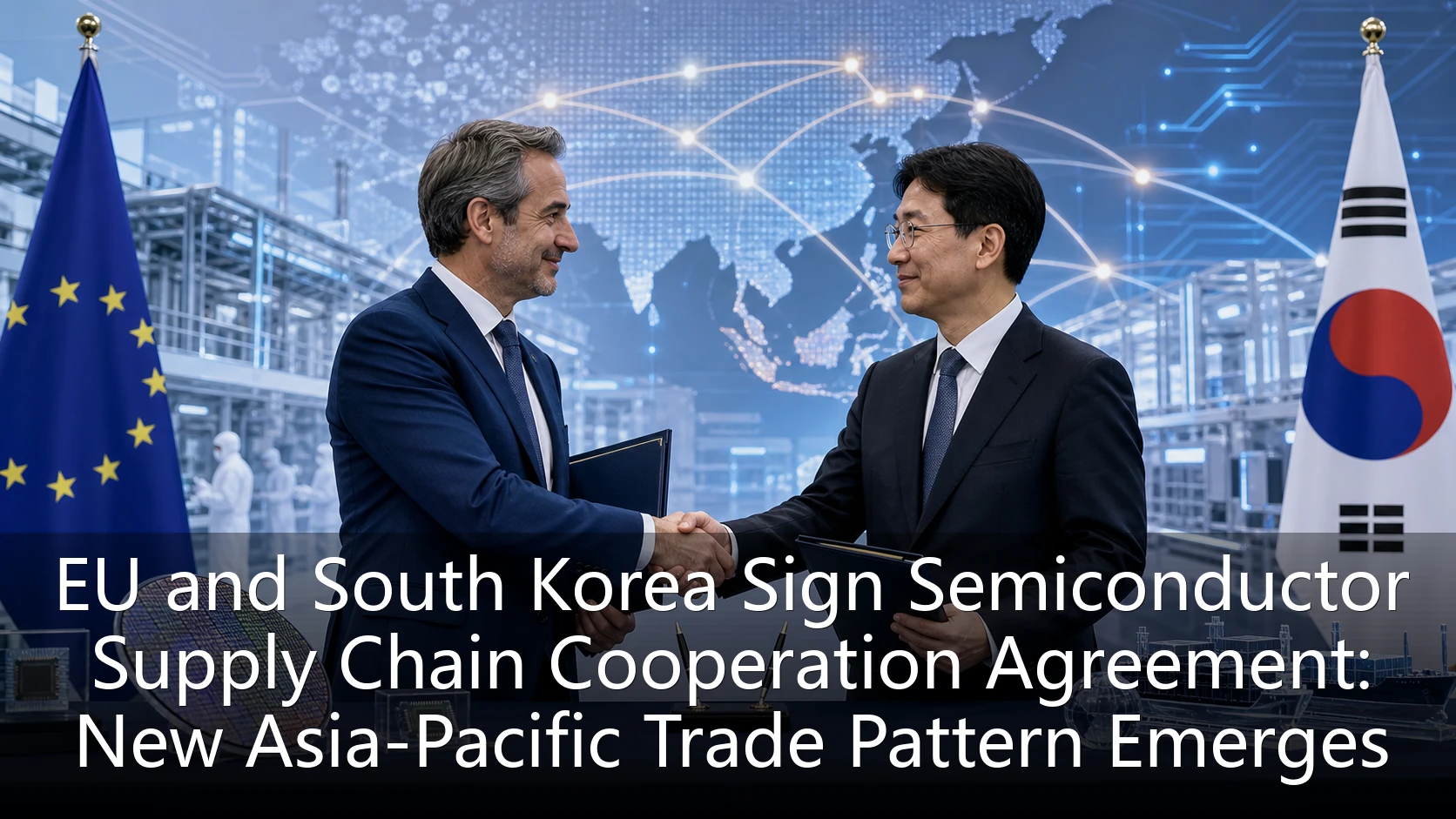
On July 28, 2026, the EU and South Korea officially signed the Semiconductor Supply Chain Partnership Agreement in Brussels. This agreement marks the first time the EU has established an institutionalized supply chain cooperation framework with a major Asian semiconductor economy, signaling that global chip trade is shifting from a focus on efficiency to one that equally prioritizes security and resilience.
Core of the Agreement: Full Chain Cooperation from Design to Recycling
According to the agreement text released by the European Commission, cooperation covers the entire semiconductor lifecycle:
- R&D and Design: Establish a joint R&D fund to focus on advanced processes below 2nm, third-generation semiconductors (silicon carbide, gallium nitride), and chip heterogeneous integration technologies.
- Manufacturing and Capacity: South Korea commits to prioritizing chip supply for key EU sectors such as automotive and industrial electronics, while the EU provides fast-track approval and subsidy support for Korean companies setting up wafer fabs in Europe.
- Key Materials and Equipment: Establish a joint reserve mechanism for strategic materials such as rare gases and photoresists, and facilitate export of EUV lithography machines and other equipment.
- Recycling and Circularity: Cooperate on developing technologies to recover precious metals from chip waste, reducing reliance on primary minerals.
The agreement also establishes a Supply Chain Early Warning System, requiring the other party to activate an emergency coordination mechanism within 30 days when a capacity gap or export control risk arises.
Background and Drivers: Geopolitics and Industry Demand
The signing of this agreement is no coincidence. Since 2025, the US-led Chip 4 alliance has stalled due to internal conflicts, forcing the EU to seek new strategic anchors. Meanwhile, South Korea's semiconductor exports, after a trough in 2025, grew 18% year-on-year to the EU in the first half of 2026, with automotive chips accounting for 43%.
EU Internal Market Commissioner Thierry Breton said at the signing ceremony: 'Semiconductors are no longer mere commodities but the cornerstone of digital sovereignty. Cooperation with South Korea will ensure Europe does not rely on a single source for next-generation communications, autonomous driving, and Industry 4.0.' South Korea's Minister of Trade, Industry and Energy Ahn Duk-geun stressed that the agreement 'is not exclusive,' and South Korea will continue trade relations with the US and China.
Impact on Asia-Pacific Semiconductor Trade Landscape
Analysts point out that this agreement could trigger a chain reaction in the Asia-Pacific semiconductor supply chain:
- Weakening of Taiwan's role? TSMC dominates over half of global foundry market share, but EU-Korea cooperation could push Samsung and SK Hynix to expand capacity in Europe, forming a Taiwan-Korea-Europe triangle that replaces Taiwan's dominant position.
- Japan's strategy adjustment: Japan previously focused on joint R&D of 2nm chips with the US, but the EU-Korea agreement may force Japan to accelerate bilateral negotiations with Europe or consider joining the EU-Korea Semiconductor Dialogue mechanism.
- China faces escalated technology blockade: Clauses on EUV equipment export facilitation may further tighten China's access to advanced processes, though South Korea remains deeply tied to the Chinese market in memory chips.
For example, a German automotive chip design company originally planned to mass-produce autonomous driving chips using TSMC's 3nm process in 2027, but TSMC's capacity has been booked by Apple and other clients until 2028. Under the new agreement, this company can instead cooperate with Samsung to use Samsung's new European fab for localized production, shortening supply chain distance and avoiding potential tariff risks.
Investor Perspective: Opportunities and Risks
From secondary market reactions, on July 28, European semiconductor equipment maker ASML and STMicroelectronics rose 2.3% and 1.8% respectively, while South Korea's Samsung Electronics and SK Hynix rose 1.5% and 2.1%. Market expectations suggest multiple Korean semiconductor suppliers will build facilities in Germany, France, and the Netherlands over the next three years, benefiting related equipment and materials companies.
However, risks remain significant:
- High execution costs: Building an advanced wafer fab costs over 20 billion euros; although both sides promise subsidies, companies still bear financial pressure.
- Technology and standard differences: The EU favors RISC-V architecture to replace ARM, while Korean companies still focus on the ARM ecosystem; this divergence may delay cooperation.
- Political uncertainty: Several European countries hold elections in 2027; if far-right parties win, they may reassess foreign industrial cooperation.
Long term, this agreement may reshape the 'plate tectonics' of global semiconductor trade: from a US-centric radial pattern to multiple regional cooperation circles (e.g., US-Japan-India, EU-Korea, China's autonomous ecosystem). Investors should monitor substitution elasticity in each link—for instance, if Korean memory chips integrate into European supply chains, alternatives in the Chinese market (like YMTC) may face fiercer competition.
Conclusion
The EU-Korea semiconductor supply chain agreement is one of the most substantive breakthroughs in global chip trade in 2026. It reflects the widespread anxiety over achieving 'chip sovereignty' and exposes the reality that no single region can be fully self-sufficient in such a highly specialized industry. For Asia-Pacific financial market participants, understanding the shift in industrial power behind this agreement is more critical than tracking short-term trade data.
OceanRing Asia-Pacific Finance will continue to monitor the implementation details of the agreement and its financial impact on relevant listed companies, providing executable strategy advice for institutional and retail investors.