
Foreign investors buy Thai bonds 260 billion baht, focus on global interest rate risk
YTD foreign net buying about 260 billion baht
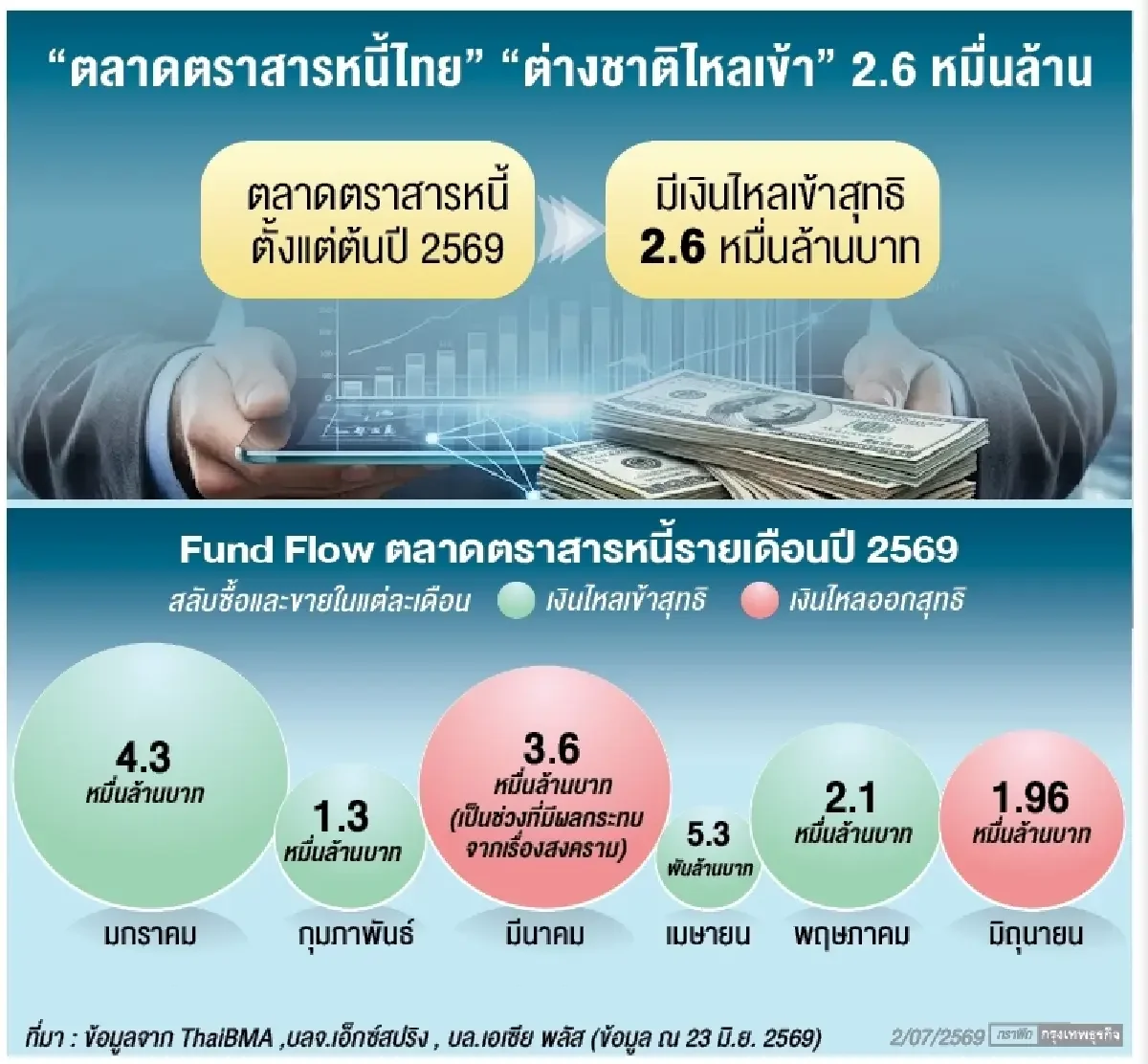
Since the start of the year, foreign net buying in the Thai bond market has been about 26,000 million baht, despite month-to-month fluctuations. Under external factors such as war, some months saw net outflows, followed by return in other months.
- YTD foreign net inflow into Thai bonds about 26,000 million baht, with monthly fluctuations.
- March saw net outflow due to war concerns, then returned to net inflow in April, accelerated in May, and began to show outflow signs in June.
- Second half faces higher external risks, especially global rate direction which may pressure the market.
- Analysts fear if the Fed raises again, it could push global bond yields higher, thus suppressing fund flows into Thailand.
Yield spread still manageable, but flows cautious
The Thai bond market in 2026 still faces volatility pressure from external factors, especially war, inflation, and global rate direction, which pushed bond yields higher in earlier periods. Meanwhile, foreign funds still recorded net inflow YTD of about 26,000 million baht, indicating continued international interest in Thailand.
Thai Bond Market Association (ThaiBMA) management indicated that bond market volatility mainly came from external factors, including the war situation in March 2026, which accelerated Thai bond yield uptrend. Compared to year-end, Thai bond yields rose about 50 bps due to inflation pressure and US Treasury market movements, but current yield levels are not yet enough to significantly impact government and corporate financing costs.
Currently, the Thai 10-year bond yield is about 2.1%-2.2%, while the US 10-year is about 4.5%, a yield spread of about 2%. Although Thai bond yields rise with global markets, it remains manageable. Fund flows also fluctuated with global conditions: net sell in March due to war; net inflow of about 5,100 million baht in April; further net inflow of about 21,200 million baht in May; net outflow signals in June.
Statistics show that YTD cumulative foreign fund flows in Thai bonds remain positive, net inflow about 26,000 million baht. Foreign holdings of Thai bonds are about 950,000 million baht, reflecting continued attention.
With the government still having high financing needs, the finance department adjusts strategy by diversifying funding sources to reduce pressure on government bond issuance during yield volatility. If issuance is too large, yields may rise more significantly.
Corporate bonds recovering but external rate risk heating up in second half
The corporate bond market is starting to see a clearer recovery. Due to war concerns and global market volatility, Q1 bond issuance fell about 15%, then large companies gradually returned to financing rhythm. Latest cumulative corporate bond issuance is about 371,000 million baht, close to the same period last year (about 378,000 million baht).
Investment strategy experts say the bond market began to show more worrying signals in the first half: foreign fund flow net inflows slowed markedly. Data shows YTD net inflow balance about 26,329 million baht. Latest data also shows foreign net selling of over 19,665 million baht, reflecting a shift from the previous year when the same period had cumulative net buying over 72,000 million baht.
In addition, the yield curve has become distorted: short-end bonds had yields lowered by buying, but 10-30 year bonds were sold, pushing 10-30 year yields up. This may impact corporates, especially those needing to issue longer-term bonds, facing higher financing costs and more difficult funding.
Research departments view that in the first half, overall foreign fund flows in Thai stocks were positive, and bonds also near 26,000 million baht net inflow, reflecting continued foreign attention; however, from June 2026, signs of flow weakening appeared.
Bond fund flows were strong at the start of the year, then turned to outflow in March 2026 due to war, back to inflow in April-May, then outflow again in June, pushing cumulative balance back to about 26,000 million baht.
Nevertheless, the second half begins with higher risk: if the Fed has a chance to continue raising rates, it could push global bond yields higher and dampen bond fund flows and overall risk asset investment sentiment.