
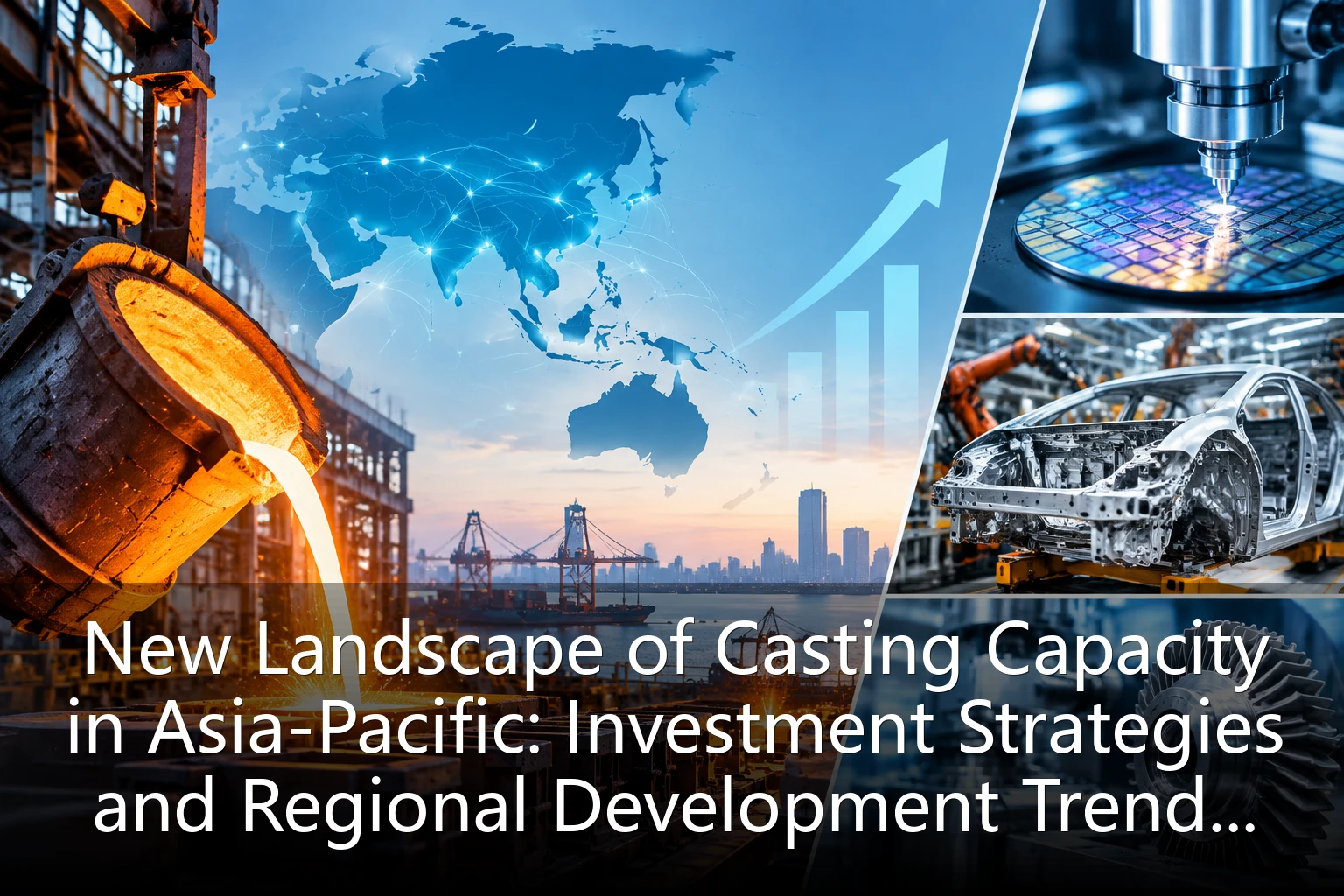
New Landscape of Casting Capacity in Asia-Pacific: Investment Strategies and Regional Development Trends for the Second Half of 2026
With the rapid development of the global semiconductor industry and the rise of emerging fields such as new energy vehicles, 5G communication, and artificial intelligence, the casting industry, as a key link supporting high-end manufacturing, is undergoing unprecedented changes and adjustments. In the second half of 2026, the casting capacity layout in the Asia-Pacific region shows new development trends, and investors need to seize the opportunities and challenges brought by regional differentiation and formulate scientific investment strategies. This article will conduct an in-depth analysis of the current status of casting industry capacity, regional development trends, and investment value in the Asia-Pacific region, providing forward-looking guidance for investors.
Analysis of Current Status of Casting Industry Capacity in Asia-Pacific
As of the third quarter of 2026, the total casting capacity in the Asia-Pacific region has reached a historical high of approximately 120 million tons/year, accounting for over 65% of global casting capacity. Among them, China, Japan, South Korea, India, and Southeast Asian countries are the major casting producers in the Asia-Pacific region, forming an industrial pattern of "China-led, Japan and South Korea-guided, and Southeast Asia-following."
In terms of sub-sectors, semiconductor casting, automotive lightweight casting, and high-end equipment casting have become the three major growth engines. In the semiconductor casting sector, with the rapid development of technologies such as AI, 5G, and IoT, chip demand has surged, driving the continuous expansion of semiconductor casting capacity. Data shows that in the first half of 2026, semiconductor casting capacity in the Asia-Pacific region increased by 15% year-on-year, reaching approximately 20 million tons/year, with an expected annual growth rate of over 12%.
In the automotive lightweight casting sector, the popularization of new energy vehicles has driven significant growth in demand for lightweight material casting. The application ratio of aluminum-magnesium alloy castings in new energy vehicles has exceeded 40%, an increase of nearly 20 percentage points compared to 2020. The automotive lightweight casting capacity in the Asia-Pacific region has reached 35 million tons/year, and is expected to maintain a stable growth of 8-10% in the second half of 2026.
In the high-end equipment casting sector, as the manufacturing upgrade in the Asia-Pacific region accelerates, the demand for precision castings continues to rise. The aerospace, medical equipment, and high-end machine tool sectors have increasingly higher requirements for the precision and performance of castings, driving the development of high-end casting capacity toward intelligence and precision.
New Regional Development Trends: Differentiation and Restructuring Coexist
In the second half of 2026, the casting capacity layout in the Asia-Pacific region shows obvious regional differentiation characteristics. As the world's largest casting producer, China accounts for over 60% of the Asia-Pacific region's capacity but is facing pressure for transformation and upgrading. On one hand, China's casting industry is accelerating toward high-end and intelligent development; on the other hand, affected by environmental policies and rising labor costs, some low-end casting capacity is gradually shifting to Southeast Asian countries.
Japan and South Korea continue to maintain a leading position in the high-end casting sector, especially in semiconductor casting and precision casting, where they have core technologies and patent advantages. Casting enterprises in both countries are actively expanding overseas markets, increasing investment in China and Southeast Asia to cope with the challenge of slowing domestic market demand growth.
Southeast Asian countries have become a new hotspot for global casting industry transfer. Countries such as Vietnam, Thailand, and Malaysia have attracted a large number of international casting enterprises to invest and set up factories by leveraging labor cost advantages and policy support. Data shows that in the first half of 2026, casting capacity in Southeast Asia increased by 18% year-on-year, ranking first in the Asia-Pacific region in terms of growth rate. It is expected that this region will continue to maintain a high-growth trend in the coming years.
As an emerging market, India's casting industry is entering a period of rapid development. With the deepening implementation of the "Make in India" strategy and the continuous expansion of the domestic consumer market, India's casting capacity is rapidly expanding, with an expected growth rate of over 12% in the second half of 2026, becoming an important driving force for the growth of the casting industry in the Asia-Pacific region.
Investment Strategy: Seizing Opportunities from Regional Differentiation and Industry Upgrade
In the face of new changes in the casting industry capacity layout in the Asia-Pacific region, investors need to adopt differentiated investment strategies to seize investment opportunities brought by regional differentiation and industry upgrading.
1. Focus on Technological Innovation in High-End Casting Fields
Semiconductor casting and precision casting are currently the most active areas of technological innovation. Investors should focus on enterprises with core technologies in semiconductor materials, precision processing technology, intelligent production, etc. For example, in the semiconductor casting field, enterprises with advanced process technology capabilities and complete supply chain systems will gain more market opportunities; in the precision casting field, enterprises mastering cutting-edge technologies such as 3D printing and micro-casting have higher investment value.
2. Seizing Investment Opportunities from Regional Transfer
With the transfer of low-end casting capacity to Southeast Asian countries, enterprises in related industrial chains will face development opportunities. Investors can focus on casting enterprises and their upstream and downstream supporting enterprises that have established operations in countries such as Vietnam and Thailand. Meanwhile, during the upgrading of China's domestic casting industry, enterprises that meet environmental standards and have advanced technology will receive policy support and market recognition, worthy of long-term attention.
3. Emphasize the Impact of ESG Factors on Investment Value
With the deepening of global sustainable development concepts, the impact of ESG (Environmental, Social, and Governance) factors on the investment value of casting enterprises is increasingly prominent. Casting enterprises that meet environmental standards and have high levels of green manufacturing will receive more policy support and market recognition, possessing long-term investment value. Investors should focus on the performance of enterprises in energy conservation and emission reduction, resource recycling, occupational health and safety, etc., and choose enterprises with higher ESG ratings for investment.
4. Focus on Investment Opportunities from Industry Chain Integration
The integration trend of the casting industry's upstream and downstream is obvious, and investors can focus on enterprises with industry chain integration capabilities. On one hand, casting enterprises extend to upstream links such as material research and development, design services, etc., to increase added value; on the other hand, they form strategic cooperation with downstream application fields such as new energy vehicles and semiconductors to enhance market competitiveness. Enterprises with industry chain integration capabilities will gain greater development space and higher investment returns.
Risk Warnings and Investment Recommendations
Although the investment prospects for casting industry capacity in the Asia-Pacific region are broad, investors still need to pay attention to the following risk factors:
- International trade frictions and geopolitical risks may affect the stability of the global casting industry chain;
- Fluctuations in raw material prices may affect the profitability of casting enterprises;
- Accelerated technological iteration may lead to the risk of elimination for some enterprises;
- Stricter environmental policies may increase compliance costs for enterprises.
In response to the above risks, investors can adopt the following strategies:
- Diversify investments to reduce risks in a single market or enterprise;
- Focus on enterprises with core technology advantages and independent innovation capabilities;
- Hold high-quality enterprises for the long term to share industry upgrading dividends;
- Closely monitor policy changes and adjust investment portfolios in a timely manner.
Conclusion and Outlook
In the second half of 2026, the casting industry capacity layout in the Asia-Pacific region will continue to show a development trend of coexisting regional differentiation and industry upgrading. Semiconductor casting, automotive lightweight casting, and high-end equipment casting will become the three major investment hotspots. Investors should seize the opportunities brought by regional differentiation, focus on investment themes such as technological innovation, regional transfer, ESG factors, and industry chain integration, and formulate scientific investment strategies.
Looking ahead, with the continuous development of the global semiconductor industry, the popularization of new energy vehicles, and the upgrading of high-end manufacturing, the casting industry in the Asia-Pacific region will maintain a stable growth trend. It is expected that by 2027, the casting capacity in the Asia-Pacific region will reach 140 million tons/year, and the proportion of global capacity will further increase. Investors should closely follow industry dynamics, seize investment opportunities, and achieve wealth appreciation.