
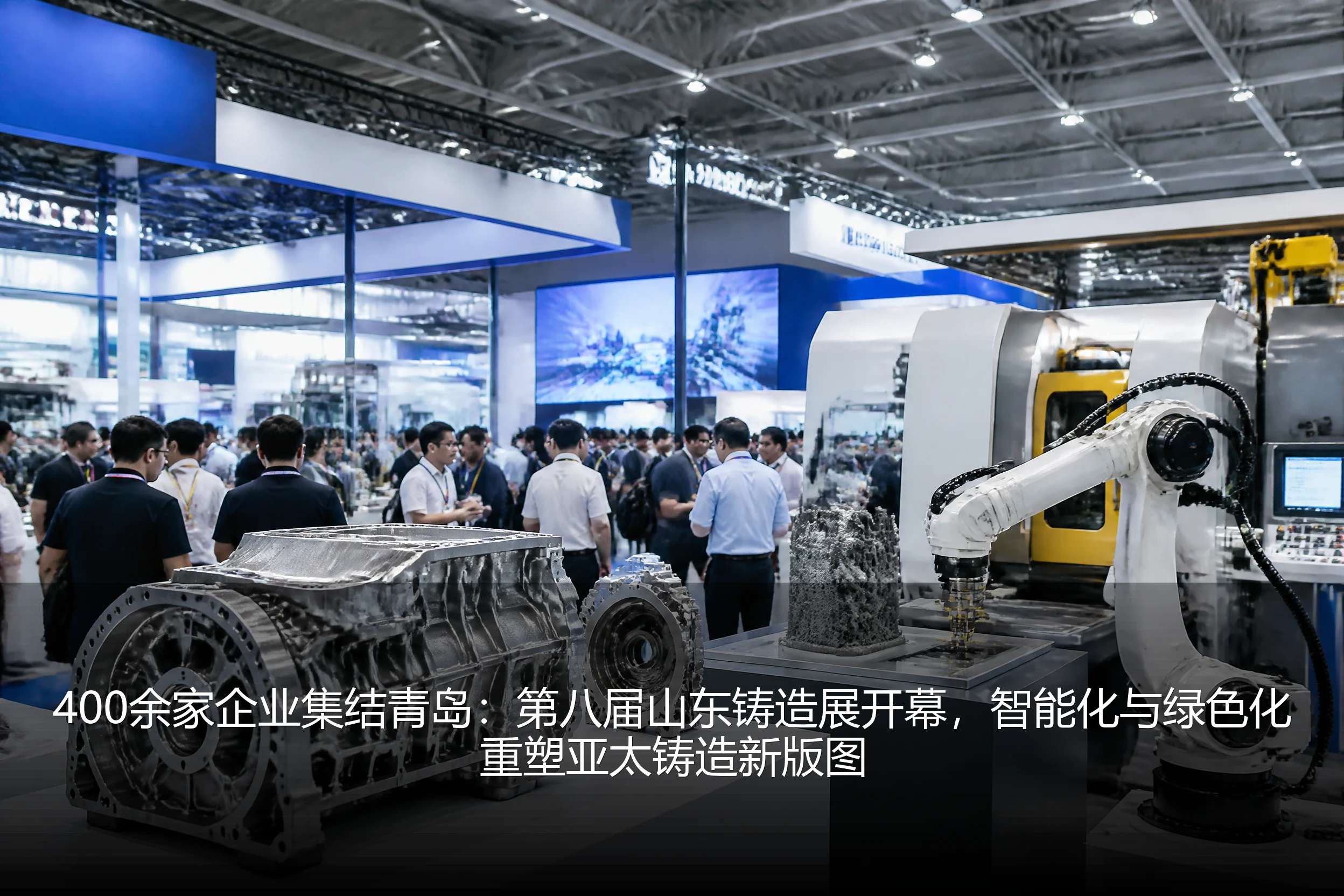
On August 6, the 2026 8th Shandong Casting Industry Exhibition kicked off in Qingdao World Expo City with the theme 'Precise Positioning, Technological Innovation', running for three days. As one of the most influential casting events in the Asia-Pacific region, this exhibition is guided by the Department of Industry and Information Technology of Shandong Province and organized by the Shandong Foundry Association, bringing together over 400 industry-leading enterprises including Meide, Binglun, Yinda, Shengquan, Jiechuang, Kaitai, etc. The exhibition area exceeds 30,000 square meters, covering the entire industry chain's core products such as high-precision castings, intelligent production equipment, green environmental protection raw materials, precision testing instruments, digital factory solutions, and environmental governance devices. Amid the accelerating restructuring of the global casting industry landscape, this 'industry benchmark' exhibition provides a rare on-site sample for observing the technological routes and investment logic of the Asia-Pacific casting market.
Three Clear Mainlines: Intelligence, Green Manufacturing, and Lightweighting Resonating in Sync
The casting industry is a fundamental part of equipment manufacturing and a key support for the iterative upgrading of high-end manufacturing. In recent years, the industry has gradually moved away from traditional extensive production models, steadily advancing toward digital intelligent manufacturing, low-carbon environmental protection, and precision efficiency. This exhibition focuses on the three transformation mainlines of intelligence, green manufacturing, and lightweighting, using a three-dimensional service system of 'exhibition + forum + docking' to break through upstream and downstream information barriers, providing practical support for technological transformation, capacity optimization, and green transition of enterprises.
A notable feature presented at the exhibition is that industry chain collaboration is evolving from 'single-point breakthroughs' to 'full-chain linkage'. The organizer held over ten industry-specific activities concurrently, among which the Shandong Industrial Machine Tool Industry Chain Casting Supply and Demand Docking Meeting is particularly noteworthy - this event integrates policy interpretation, CNC machine tool roadshows, technical analysis, and supply-demand negotiations, directly promoting efficient matching between casting demand and supply sides. This 'exhibition-sales docking + technology empowerment' model reflects the deep changes in the casting industry's supply chain management from extensive to refined, echoing the broader trends of manufacturing returning to Asia-Pacific regions and accelerating regional layout.
Intelligent Equipment Makes a Strong Appearance: Quality Transformation from Automation to AI Inspection
Intelligent equipment is one of the biggest highlights of this exhibition. Several independently developed devices directly address pain points in mass production and quality inspection: the fully automatic vertical shoot-squeeze molding machine relies on high-pressure sand shooting technology and a full-process automatic control system, meeting the needs for large-scale, standardized mass production of small and medium-sized castings; the AYS01 intelligent environmental casting production line integrates multiple environmental treatment systems, balancing high efficiency and clean production; supporting equipment such as 3D printing rapid prototyping technology and intelligent warehousing and logistics systems complement the shortcomings in casting R&D, production, and warehousing circulation, improving the entire intelligent production system.
Particularly noteworthy is the debut of China's first UNT160D large-scale die-casting part X-ray inspection equipment at this exhibition. Equipped with AI algorithms, this equipment overcomes industry challenges in non-destructive testing of large complex components, and together with a series of intelligent polishing equipment, can provide comprehensive solutions for intelligent transformation of the entire process. Industry analysts point out that the large-scale application of AI inspection equipment means that the 'last mile' of the casting industry - the quality control link - is being digitally reconstructed. For investors, companies with dual capabilities in 'intelligent equipment + inspection algorithms' are expected to gain higher bargaining power and gross margin flexibility in the next capacity upgrade cycle.
3D Printing and Precision Casting Accelerate Integration
The concentrated display of 3D printing rapid prototyping technology at the exhibition further confirms the trend of deep integration between additive manufacturing and traditional casting processes. The signals released from the exhibition show that sand 3D printing is moving from laboratories to production workshops, achieving engineering applications in fields such as wind power castings and large machine tool cores. This technical path can break through the constraints of traditional molds, supporting integrated molding of complex internal flow channels and fine topological structures, significantly improving material utilization while shortening development cycles. As printing efficiency and cost bottlenecks are gradually overcome, 3D printing is expected to become the most explosive growth track in the precision casting field.
Green Technology Breakthrough: New Casting Paths Under Dual Carbon Goals
New green processes and low-carbon new materials inject new momentum for the industry to implement the 'dual carbon' goals. The new green molding material 'Casting Element' debuted at the exhibition can replace traditional raw materials, reducing pollutant emissions from the source and filling the technical gap in this field in China; the FCF-2R annular foam ceramic filter has a filtration throughput three times that of conventional products, significantly improving the purification accuracy of molten metal and the yield of castings; V-method and lost foam production lines can effectively reduce auxiliary material consumption, with old sand recovery rate exceeding 95%, and together with supporting energy-saving equipment, they build a low-cost, low-energy, low-pollution green casting integrated solution.
From a policy perspective, green manufacturing is no longer an 'option' but a 'necessity'. In recent years, international trade rules such as the Carbon Border Adjustment Mechanism have continued to put pressure on energy-intensive industries. As a typical high-temperature and high-energy-consumption process, casting is facing comprehensive transformation from energy structure, raw material systems to emission control. The technologies displayed at the exhibition, such as old sand recycling, green molding materials, and environmental production lines, are essentially proactive layouts by enterprises to cope with rising compliance costs and enhance international competitiveness. It can be predicted that casting enterprises with green process reserves and ESG governance capabilities will win more overseas orders and capital favor in the Asia-Pacific supply chain restructuring.
Industry Analysis: Asia-Pacific Casting Market Faces Three Major Changes
From the research perspective of OceanRing Asia-Pacific Finance, the information released at this exhibition can be mutually confirmed with the macro trends of the Asia-Pacific casting market, mainly reflected in three aspects:
- Structural upgrading of demand side. Emerging demands such as new energy vehicle integrated die-casting, humanoid robot structural components, and data center heat dissipation components are rapidly growing, promoting the continuous increase in the proportion of high-value-added castings such as aluminum alloys and magnesium alloys, and the traditional capacity structure dominated by gray cast iron is facing adjustment pressure.
- Regional reshaping of supply side. Under the considerations of geopolitics and supply chain security, multinational enterprises are accelerating capacity layout in Southeast Asia and South Asia. Meanwhile, China's casting industry, with its complete industry chain supporting and first-mover advantages in intelligent transformation, is transforming from a 'low-cost manufacturing base' to a 'high-end technology exporter', and the regional division of labor continues to evolve.
- Fusion innovation on technology side. The cross-penetration of technologies such as AI inspection, 3D printing, and digital twins with traditional casting processes is rewriting the industry's cost curve and competitive barriers, technology-intensive small and medium-sized enterprises are facing a historic window for 'overtaking by changing lanes'.
Outlook: The Critical Leap from Scale Expansion to High-Quality Development
The organizer stated during the exhibition that it will continue to play its role as an industry hub, promoting the digital and intelligent transformation and green low-carbon upgrading of Shandong's casting industry, guiding the industry to shift from scale expansion to high-quality, high-end, and refined development. This statement is actually a microcosm of the entire Asia-Pacific casting industry - as global manufacturing enters a new technological cycle, this 'most traditional' industrial link is, with the dual support of intelligence and green manufacturing, once again becoming the focus of capital and industry attention.
For investors concerned about the Asia-Pacific supply chain, the core signal conveyed by this exhibition is: the competition dimension of the casting industry has shifted from a single 'tonnage and price' to a comprehensive competition of 'process precision, digital level, and green compliance capabilities'. Those enterprises that are the first to complete intelligent transformation, establish green process barriers, and deeply embed in the new energy and high-end equipment industry chain are expected to continuously expand their share in the next round of industry reshuffling, becoming the biggest beneficiaries of the structural growth of the Asia-Pacific casting market. As the exhibition deepens from August 6 to 8, more technical details and order dynamics are worth continuous tracking.