
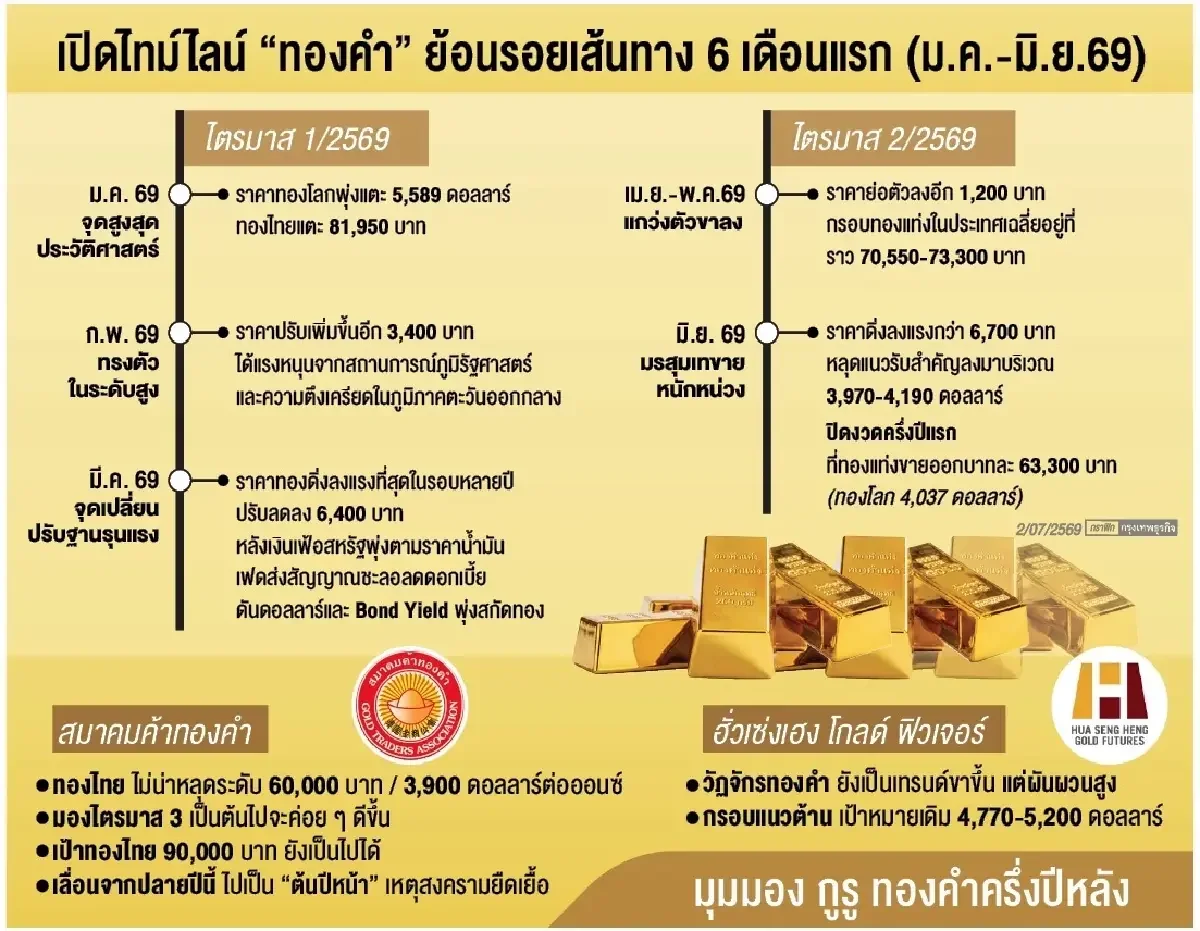
2026 H1 gold surges and plunges: closes around 60,000 baht
First half "peak to trough": gold price fell from 81,950 to about 63,300 baht
Gold prices fluctuated sharply in the first half of 2026 (Jan-Jun), hitting an all-time record high of about 81,950 baht per baht-weight, then falling to close around 63,300 baht. The Gold Traders Association believes gold prices may gradually improve in the second half of 2026, with a key factor being continued central bank gold purchases globally, providing price support.
Key drivers for rally and correction: geopolitical tensions and Fed signals
Gold's rise in the first half was mainly related to geopolitical tensions, driving capital into gold as a safe haven. Meanwhile, the Fed's signal that "rate cuts will slow" put pressure on gold.
On January 29, gold prices hit a global high (5,589 USD/oz). This drove Thai gold (gold bars) to a historic high in baht terms. The Association noted that gold prices had to be adjusted frequently within the day, and the range was the most expensive ever: 77,900-81,950 baht per baht-weight, up 9,250 baht from end of previous year. In February, gold remained high and rose further by about 3,400 baht, supported by safe-haven buying from Middle East tensions.
Sharp sell-off in June and key support: drop to about 4,037 USD/oz
Price movement showed a "downward consolidation", with domestic gold bar average range narrowing to about 70,550-73,300 baht. The strongest sell-off occurred in June, with prices falling more than 6,700 baht; the month saw the most volatility, breaking key support levels, fluctuating in the range of about 3,970-4,190 USD/oz, with intraday lows near 3,970. As a result, Thai gold prices suffered a bigger impact.
On June 30, half-year close: buyback price about 63,100 baht, selling price about 63,300 baht. Corresponding global gold price about 4,037 USD/oz. Q2 also saw a correction; overall, much of the first half volatility came from global uncertainty, especially the lack of clear progress in the war situation.
March turning point: US CPI and rising yields weighed on gold
March was seen as a clear turning point. Higher US inflation (CPI) data and rising oil prices led to expectations of slower Fed rate cuts. The dollar and US bond yields rose, subsequently suppressing gold performance through Q2. In April-May, gold prices remained in a declining range, cumulatively falling about 1,200 baht.
Association chairman "Jitthi Tangsitfakdi" stated that the gold market exhibited historically high volatility, with both "new highs" and "new lows". Especially on January 29, prices surged to new highs, and such daily changes required investors to adjust strategies quickly.
Second half outlook: central bank buying and rate expectations may be key support
For the second half direction, even if short-term uncertainty remains from Iran-related war factors, some believe gold may gradually recover after Q3. Main support comes from continued central bank gold buying: while accumulating gold, central banks also reduce (or dispose of) USD bonds and shift to gold as reserve assets, providing price support.
In addition, some believe the Fed rate policy is unlikely to rise. Given the heavy US government debt burden, the additional cost of rate hikes may be hard to bear; this is seen as a direct positive for gold. If the US economy shows more clear problems due to prolonged war, it may further drive more capital to gold as a reserve choice.
Also, year-end seasonal factors exist. Generally, gold funds tend to increase holdings at year-end. Although the market still worries whether Thai gold prices will fall below 60,000 baht, "Jitthi" believes the likelihood of falling below 60,000 is low, because prices have shown strong resilience during declines: they once pulled back near 3,900 USD/oz but then recovered above 4,000 USD/oz.
Regarding the previous Thai gold price resistance target (90,000 baht), there may be a delay beyond the original expectation: if the war lasts longer than anticipated, combined with speculative volatility in futures markets (e.g., high volatility in China and regulatory risks), the timeline may extend from year-end to early next year, requiring investors to be cautious and monitor closely.
Tax discussion and investment strategy: beware of policy impact, focus on buy-on-dip
Regarding the "gold transaction tax" topic, the Gold Association's stance is that if such a tax is imposed, it would cause the Thai gold industry to "go backwards" and affect regional competitiveness. Currently, although relevant authorities have held discussions with some companies, no tax implementation information has emerged.
Hua Seng Heng Gold Futures CEO "Thanarat Phasuwong" believes the 2026 gold cycle remains in an upward trend, but given high price levels, volatility is expected to be significant. His original target range was 4,770-5,200 USD/oz, recommending a "Buy on Dip" strategy, waiting for price pullbacks near key support before allocating.